
Larry Skutchan
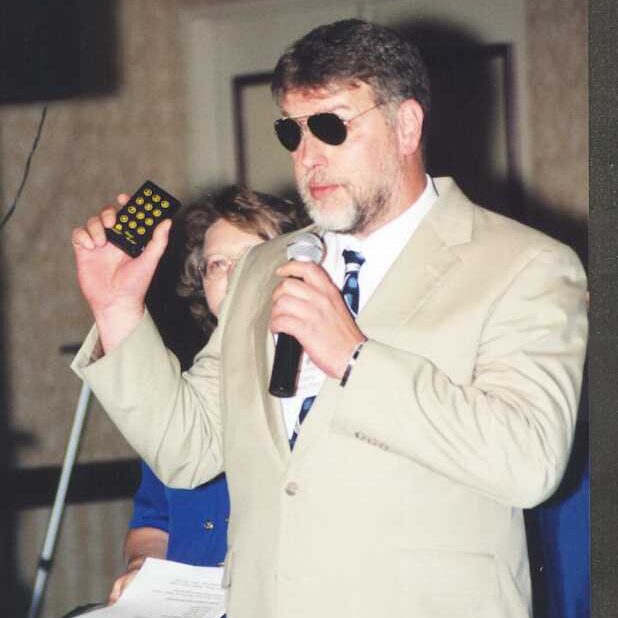
Biography
Larry Skutchan is a well-known innovator who has crafted tools to raise the quality of life for so many. A huge contributor to the access technology world who has been integral in pushing the field forward, his contributions and influence will always be felt in the lives of the blind or low vision.
Early Life
Larry Skutchan grew up in an Air Force family, spending his childhood in Germany and various parts of the United States alongside his two younger sisters. He often credits his mother’s lively Cajun family for many of his fondest early memories. When he reached Junior High, his father retired and moved the family to a farm in Hope, Arkansas.
After high school, Skutchan trained in air conditioning and refrigeration while working as a derrick repairing oil wells across Texas, Arkansas, and Louisiana. During this period, the retina in his right eye detached. Having already lost sight in his left eye, he underwent surgery, but scar tissue eventually caused complete vision loss when he was around the age of 21.
This turning point led Skutchan to Little Rock where he enrolled at the University of Arkansas. Initially majoring in English and Political Science, he soon became captivated by the emerging personal computer revolution. Early PCs offered what he later described in the Braille Monitor as a “liberating, exciting, and enlightening sensation,” especially at a time when information was difficult to access.
Career
Not being able to read his typed work as he navigated college pushed Skutchan to develop his own word-processing program. “Necessity is the mother of invention,” Skutchan said. What began as a personal solution gained attention after he placed an ad in a disc-based newsletter. Soon after, the Kentucky Department for the Blind contacted him about purchasing the program for medical transcribers, and that connection led to a job recommendation at The American Printing House for the Blind (APH), marking the beginning of a career that would shape accessible technology for decades to come.
Skutchan joined APH in 1985 as a Systems Programmer, creating accessible educational software for Apple computers. Outside of APH, he created ProWORDS, a talking word processor, and served as one of the editors to BAUD (Blind Apple Users Discussion) magazine. In 1993, he left APH to pursue his dream of writing leading accessible software, Automatic Screen Access Program (ASAP) and Automatic Screen Access Program for Windows (ASAW) – programs that became foundational in screen access technology.
His return to APH in 1998 “brought APH immediate validity as a provider of valuable technology for the blind,” said Tuck Tinsley, former President of APH. Over the next two decades, Skutchan contributed to major APH products, including Book Port, Mobile Manager, BraillePlus 18, Orbit Reader 20, Braille Blaster, and Mantis Q40. In a 1999 Chicago Tribune article he reflected on the limitations blind users face with visual media: “You know an illustration is worth 1,000 words…but we can’t see it.” His dream of a tactile graphic display was realized in 2024 with the release of the Monarch. Retiring in 2020 as APH’s Director of Technology Product Research, Skutchan received The Wings of Freedom Award, APH’s highest honor, at the 2023 Annual Meeting.
The Dot Experience
Being remembered alongside so many accomplished individuals in The Dot Experience cast is an honor Skutchan deeply values. Recently reading Apple, the First 50 Years reminded him of the early days of computing – a frontier where independent software developers were just beginning to emerge. “Software development came along at the right time, and I had a knack for it. It gave me a way to build user interfaces from almost nothing – just your ideas and the tools you had. That was impactful.”
Skutchan hopes The Dot Experience will be an agent for change in educating the public and reshaping perceptions about what blind or low vision people can achieve. “I hope that the stories presented in the cast exhibit can inspire hope, ideas, dreams, and aspirations within the blind or low vision community,” Skutchan said. Beyond that he hopes the museum encourages broader awareness of accessibility needs – from braille labeling to accessible packaging to the possibility of blind people operating self-driving cars one day.
Now living in Florida, Skutchan enjoys a quiet life filled with sunshine, reading, and long walks. Although he sometimes misses the shops and energy of Frankfort Avenue near APH, he is proud of the work he contributed and the impact it continues to have.