
George Stern
Biography
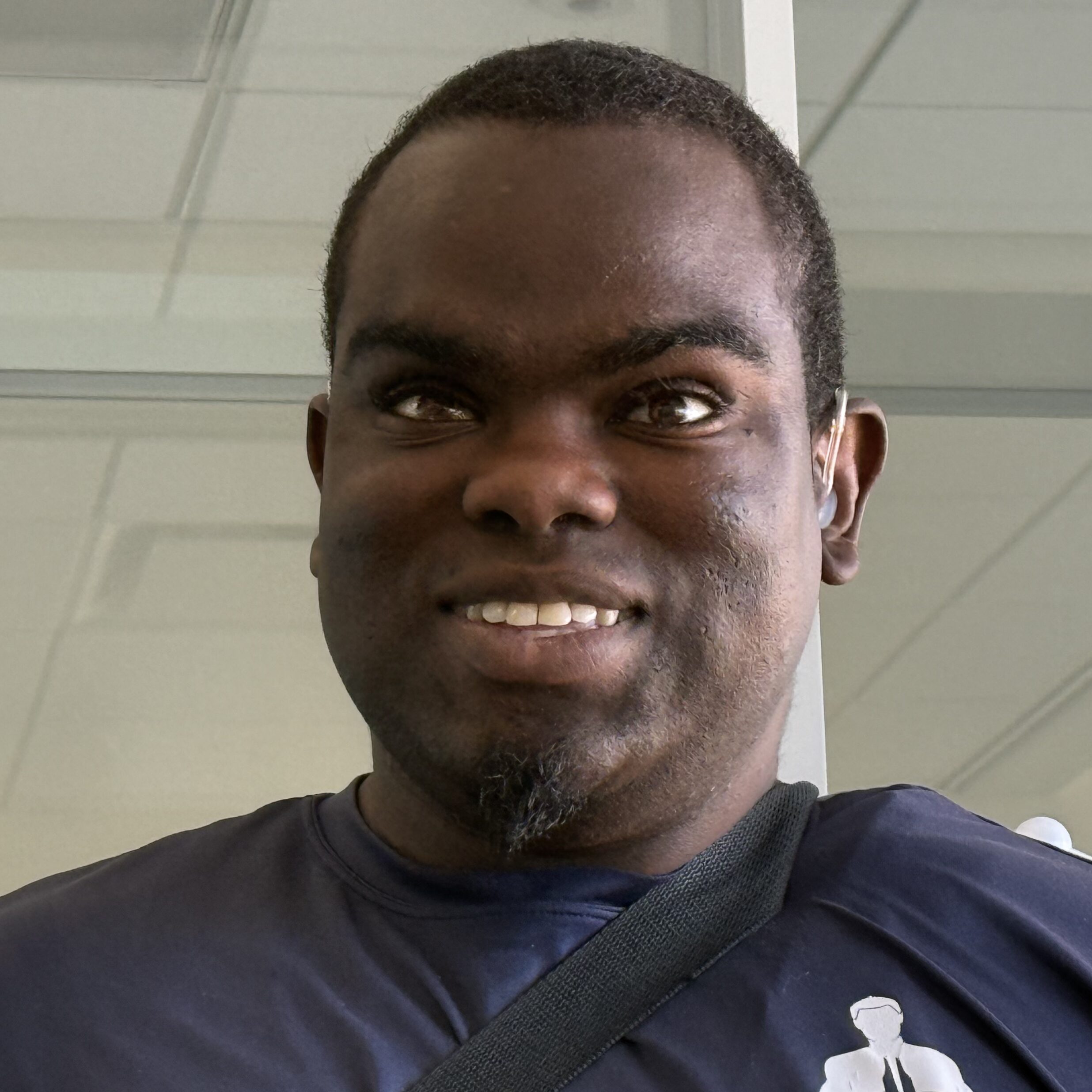
Interested in food, linguistics, and social justice, George Stern uses his talents to challenge assumptions about disability. He believes that meaningful connections are essential to living a full and purposeful life, and is dedicated to helping other individuals who are blind or have low vision realize the importance of community and maintaining it.
Listen to our Change Maker’s podcast to hear more about how George advocates for accessibility in unexpected places.
Early Life
Born in Spanish Town, Jamaica, Stern has vivid memories of his early childhood, recalling the taste of fresh coconut and the smell of fried fish ─ even the sharp sting of sugarcane barbs in his hands. “My parents were convinced I was a soccer player in the making because I had a constant habit of kicking things as a young child,” Stern said. “After I began running into things, they shone a flashlight into my eyes and discovered an unusual reflection.”
Initially misdiagnosed with pink eye, Stern was later diagnosed with Retinoblastoma, a rare form of eye cancer. He and his family immigrated to South Florida, but it was too late for treatment. At that point, Stern had lost his sight. By the age of three his eyes were surgically removed, and he has worn prosthetic eyes ever since.
“Looking back, I realize the profound impact my blindness had on my parents,” Stern said. “Even so, I remember how determined they were that I would have every opportunity to thrive.” Stern’s father, who grew up in a Jamaican orphanage, understood the importance of literacy and independence, having taught himself to read at the age of fourteen. Not only did his parents read countless materials aloud to him, but they also ensured he had access to books through recordings. “Their commitment helped foster a lifelong love of learning,” Stern said.
Sandy Edmond was a pivotal influence in Stern’s life. A Teacher of the Visually Impaired (TVI), she encouraged Stern’s family to enroll him in mainstream public school, which quickly became his “happy place” despite an initially turbulent transition. Although he began experiencing hearing loss around the age of four, he wasn’t introduced to the DeafBlind community until high school. “I eventually embraced my DeafBlindness, which transformed how I understood myself and interacted with others,” Stern said.
Career
Exploring a wide range of interests at Texas Tech, Stern studied journalism, exercise science, and numerous languages, including French, Latin, Russian, Arabic, and Portuguese. He holds a bachelor’s degree in French, a master’s degree in curriculum and instruction, is currently a research assistant with the Center for STEM Learning at the University of Mississippi and has been accepted into a doctoral program at Boston College.
Although he gained orientation and mobility (O&M) skills as an adult that expanded his independence, Stern struggled with isolation and building community in Texas due to transportation barriers. The experience took a significant toll on Stern’s mental health and taught him one of life’s most important lessons: “Skills are great, but community is even more important,” Stern said. “Without community, I would not be here.”
Today, that belief shapes much of his work. Learning to live and be with people who are different than himself, Stern says that he considers himself fortunate to have a community made up of different people with varying perspectives.
Outside of academia, Stern is an advocate for accessibility in unexpected spaces. As a contributor to the food publication Serious Eats, he challenged editors to make recipes and food content more accessible through detailed image descriptions. The effort helped raise awareness that people who are blind cook, experiment, and engage deeply with food culture, too.
For Stern, it’s ultimately about participation. “Being blind or DeafBlind does not diminish a person’s desire to contribute; they simply change how that contribution happens,” Stern said. “Humanity doesn’t stop at disability, it simply changes. That’s where I see my role in The Dot Experience.”
The Dot Experience
As a cast member, Stern says he appreciates the focus on braille and the many dimensions of identity that exist beyond assistive technology. “I like that the focus has been on the different facets of each cast member. Trying to widen people’s perspective on what it is like to be blind or DeafBlind is always a good idea,” Stern said. “People need to be able to see ─ we need to be able to see the “human” in ourselves.”
Whether through research, advocacy, athletics, languages, or storytelling, Stern continues to challenge assumptions about blind or low vision communities. His message is simple but powerful, “Blindness doesn’t take away the desire to contribute or the ability to contribute – it just means you have to get more creative about how you do it.”