
Pete Eckert
Biography
Artist, sculptor, and photographer, Pete Eckert considers himself a trailblazer. He hopes to “cut a path wide enough for people to follow,” and offer people who are sighted a glimpse into what people who are blind or have low vision are capable of.
Early Life
Born into an Air Force family at Wright-Patterson Air Force Base in Dayton, OH, Eckert grew up as the second oldest of five children. As a child, Eckert experienced severe dyslexia and struggled academically, except in classes where he could build or create. During his high-school years, he dropped all academic courses and took only art or auto-shop classes. He later attended The Art Institute of Boston, earning a diploma in sculpture and ceramics. After graduating, he followed his friends to San Francisco State University where he completed his degrees in art as well as design and industry.
Eckert originally planned to study architecture at Yale, but everything changed when he was diagnosed with Retinitis Pigmentosa (RP) in September 1982 at age 25. “One morning while I was in grad school I woke up and had lost a lot of vision,” he said. “I had trouble just walking.” He changed his objective from architecture to business and got an MBA at the University of Hartford.
Career
Although he did not fully lose his vision until 1996 at the age of 40, his diagnosis affected his career prospects. Eventually finding work with the State of California, Eckert soon realized government work wasn’t the right fit for him and decided to pursue life as an artist. Known internationally as “The Blind Photographer,” Eckert has retro-engineered his equipment to make photography accessible. Using sound and touch he “memorizes the event of taking photos.”
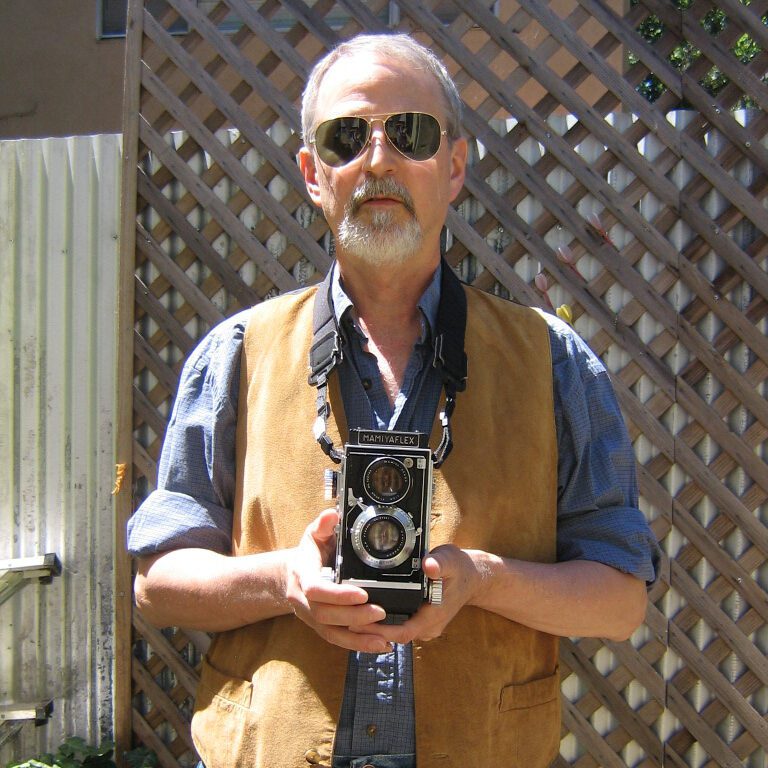
Eckert has a fully adjustable Mamiyaflex, covered in braille dots and filed notches. “My wife put braille dots all over it─ the settings, the focus rails…I took a jeweler’s file and filed down different distances to focus a camera,” he explained. Another favorite camera, a Retina 2, includes an infrared setting. “That was my entry into very slow-speed work,” he said. His Weston Model 4 light meter, powered by selenium, has had its glass taken off, braille dots added, and is easily recalibrated using the locking mechanism. Eckert fashioned a functional dark room by placing a low-wattage light bulb in a ceiling fixture and utilizing an auditory timer.
“There is a blind photography movement. I am at the forefront of that movement,” he said. “Any blind person can take a photo. I went after it to be a trailblazer─ to cut a path wide enough for other blind people to follow.”
The Dot Experience
Eckert is honored to be part of The Dot Experience because he sees it as recognition of the path that he has carved. He hopes the exhibit gives sighted people a clearer understanding of what is possible for people who are blind or low vision. His goal is to give the blind community hope.
“We can climb mountains,” Eckert said. “Blind people can do a lot of different things. You’re not only showing blind people what is possible and giving them a trail to follow,” he said. “You’re showing sighted people that they shouldn’t put up so many barriers. The biggest barriers I face are the assumptions of the sighted.”
Pete currently resides in California with his wife and guide dog.
To keep up with what Pete is up to next, follow him on Instagram or visit his website.