
Zulal Tannur
Biography
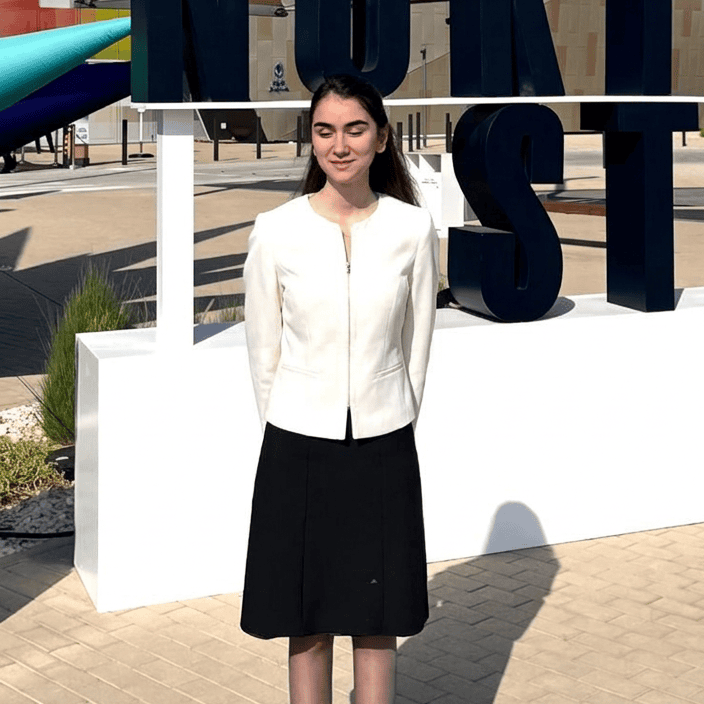
Game builder, cognitive neuroscientist and DeepTech entrepreneur, Zulal Tannur’s vision is to design enhanced perception that closes the gap between machines and humans. She hopes people will see the global impact of leaders who are blind or low vision and is honored to be placed alongside her role models in The Dot Experience.
Early Life
Zulal Tannur was born three months premature with only five percent vision. Unable to easily recognize colors, objects, or human faces, her earliest childhood memories involve playing games to help memorize objects and recognize her surroundings. By the age of four, she had begun to use a computer, uploading images of her family and friends to teach her brain facial recognition.
Because her vision differed from her peers, Tannur often felt excluded from their games. Her solution: build her own games. “I thought that if I could build the kids’ favorite games, they would volunteer to play with me, so I became a game builder,” explained Tannur. Today, she is still a game builder, but on an adult scale. “I’m a game builder because I still believe that if I’m not, I cannot be a player in the game,” said Tannur.
Tannur had lost her vision completely by the age of 10. Having learned the details of objects, colors and faces up to that point, she began using image-recognition technology for accessibility. Realizing that there was a huge gap between those technologies and biological vision which detects everything in real time, Tannur decided to become an entrepreneur.
Career
Throughout high school, Tannur volunteered on projects to increase accessibility and traveled across Turkey teaching STEM to students in disadvantaged villages. Through these experiences, she learned how to build, lead and launch startups. Mentored by NVIDIA Co-Founder Chris Malachowsky and Microsoft CEO Satya Nadella, Tannur has founded three startups. One is Myelion, a new artificial intelligence (AI) inference architecture designed to deliver maximum accuracy with minimal compute power.
Initially attending Boğaziçi University in Turkey, Tannur currently studies neuroscience and cognitive sciences at the University of Arizona. Her dream is to become the first neuroscientist who is blind. Focusing on human perception and neurodiversity, she hopes to design enhanced perception that closes the gap between machines and humans. “My vision is very clear: I want to hack biology with technology,” said Tannur. “We know that human potential is unlimited, but we have limited hardware.”
Tannur views human biology as that hardware. “The brain is a perfect hardware, cognition is the software, and our organs are like sensors,” said Tannur. “The sensors capture the data and deliver it to the hardware, and our cognition, our software, processes it. That means we can change how it is processed.”
She believes that AI and human biology will collaborate with each other to achieve artificial general intelligence (AGI) and other advanced biohacking technologies. “Our next-generation AI is not going to run on silicon chips or huge data centers,” said Tannur. “In my view, those technologies will run on human biology. It’s going to be a perfect collaboration. I will dedicate my life to it.”
The Dot Experience
Being a part of The Dot Experience cast is meaningful for Tannur because it places her alongside her role models. “My family and I had no idea if my future was going to be full of potential or much bleaker,” said Tannur. “Thanks to the role models that we had, my family believed in me, had hope and designed my early steps looking to the stories of my role models. Now, I’m together with my role models as a cast member.”
Tannur hopes that many people will see the global impact of leaders who are blind or low vision through The Dot Experience. “Technology leaders, artists, scientists, entrepreneurs, and more,” said Tannur. “Individuals who are blind or low vision have led history many times and they are still doing it. I hope The Dot Experience will show people those examples and future possibilities.”
While most museums offer minimal accessibility, Tannur is excited by the full inclusion at The Dot Experience. “You normally need more support at other museums, like human guidance, descriptions of things you need to touch because often times touching isn’t even permitted,” said Tannur. “When we look at The Dot Experience, accessibility comes first. It’s not an option. It’s a mandatory requirement. It’s the main purpose.”
Zulal Tannur has a 4-year-old British cat, Poncik, named after a Turkish pastry that resembles a croissant. When she is not setting global precedents in AI, she enjoys trekking, eating good food and spending time with friends. To keep up with Zulal and what she’s up to next, you can follow her on LinkedIn, Instagram or Medium